Codes and Conventions of the Documentary Genre
Single strand narrative
Editing: Cut is most common edit - does not distract from what is going on, on screen
Voice over - holds the narrative together (glue) Variety of relevance
Relevant depending on topic, relevant age to the topic, standard english, calm and clear delivery
Creative and Varied Camerawork - conventional framing on interviews - sitting on a stable chair
Camera usually static on a tripod not hand held
Images (moving and still) - Camera movement when filmin still images
Archive material
If Chromakey is used it shouldn't detract from an interview
Relevant music - doesnt abtract ot interfeer with the interview
Graphics - Anchor person - time, place and relevance to programme 0 usually 2 lines
Monday, 20 September 2010

Tuesday, 7 September 2010
Different Types of Documentary
Fully Narrated
A voiceover is used to convet the exposition. The voiceover is used to make sense of the visuals and dominates the meaning. E.g Natural history documentarys.
Fly on the Wall
Draws on the french film movement of 'cinema verite'. The camera is unseen or ignored and comply records real events as they unfold.
Mixed
A combination of interview, observation, actuality and archive material and narration to advance the argument/narrative.
Self - Reflective
When the subject of the documentary acknowledges the presence of the camera of often speaks direcly to the programme maker.
Docudrama
Re- enactment of events
Docusoap
Documentary and soap opera. A group of central protagonists and follows the characters. E.g Airline
A voiceover is used to convet the exposition. The voiceover is used to make sense of the visuals and dominates the meaning. E.g Natural history documentarys.
Fly on the Wall
Draws on the french film movement of 'cinema verite'. The camera is unseen or ignored and comply records real events as they unfold.
Mixed
A combination of interview, observation, actuality and archive material and narration to advance the argument/narrative.
Self - Reflective
When the subject of the documentary acknowledges the presence of the camera of often speaks direcly to the programme maker.
Docudrama
Re- enactment of events
Docusoap
Documentary and soap opera. A group of central protagonists and follows the characters. E.g Airline
Features of Documentaries
John Corner of the University of Liverpool said there are 5 central elements of the documentary
- Observation - The programme makers pretend the camera is unseen or ignored by the people tking part in the event. This puts the audience in the position as an eye witness.
- Interview - People give opinions and information. Documentaries often rely heavily on interviews.
- Dramatisation - All documentaries use a sense of drama through the observation element.
- Mise-en-scene - Documentary makers carefully contruct shots.
- Exposition - The line of argument in a documentary. It can be viewed as what a documentary is saying to an audience.
Documentary Definition and Purpose
The purpose of the documentary is to document that is to report with evidence, something that has actually happened. It can show this by using actuality footage or reconstruction. It can use a narrators voiceover to anchor the meaning or rely on thr participants themselves with perhaps the noccasional interjection by the narrator.
John Grierson ran a team called the general post office film unit (GPO) in the 1930's. In the second world war the GPO made documentarys showing everyone working hard, laughing and singing they were seen to be used as a propaganda tool.
John Grierson defined doumentary as: "The creative treatment of actuality"
John Grierson ran a team called the general post office film unit (GPO) in the 1930's. In the second world war the GPO made documentarys showing everyone working hard, laughing and singing they were seen to be used as a propaganda tool.
John Grierson defined doumentary as: "The creative treatment of actuality"
Monday, 12 July 2010
Evaluation
Evauation of Preliminary Task
We watched our clips as a class on YouTube and gave eachother evaluative comments
One of the strengths of our documentary was the cutaways, as they were inventive and linked well to what was said in the answers of the interviewee. Although out mise en scene was relevent to the documentary subject it was poor as it was only one picture. To inprove the mise en scene of the picture in the background the picture should be printed off many times to make a 'wallpaper'. The framing of out documentary was also a weakness as the eyeline of the interviewee should be around a third down the screen, ours wasn't. The levels on the music to speech ratio was not right as the music was too loud and the interviewee could not be heard. Our last strength was the questions, as they made sense without the question from the interviewer being heard.
To improve our interview it must follow the codes and conventions of a interviewee more carefully.
We watched our clips as a class on YouTube and gave eachother evaluative comments
One of the strengths of our documentary was the cutaways, as they were inventive and linked well to what was said in the answers of the interviewee. Although out mise en scene was relevent to the documentary subject it was poor as it was only one picture. To inprove the mise en scene of the picture in the background the picture should be printed off many times to make a 'wallpaper'. The framing of out documentary was also a weakness as the eyeline of the interviewee should be around a third down the screen, ours wasn't. The levels on the music to speech ratio was not right as the music was too loud and the interviewee could not be heard. Our last strength was the questions, as they made sense without the question from the interviewer being heard.
To improve our interview it must follow the codes and conventions of a interviewee more carefully.
Friday, 9 July 2010
Thursday, 8 July 2010
Adobe Premiere Screen Grabs

This is the clip speed and duration properties box. We used this to speed up our cutaways because some of them lasted too long to be classed as cutaways.

This is the razor tool, we used this to cut out the questions in our interview. This made the interview easier to create.

This is the set out and start point icons, this was used on the cutaways, it ensured only the cutaway was selected.
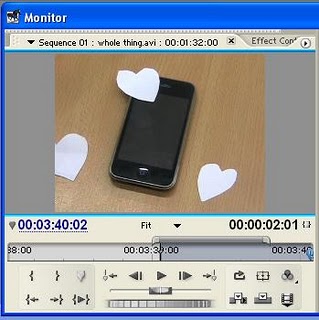
This is another screen capture of the monitor but with the cutaways being edited.

This is how the finished product looked on the time line. The cutaways are above and slightly overlapped so the interview ran smoothly.

We then added a song and lowered the volume so that the interview could be heard.
Subscribe to:
Posts (Atom)